
Afridigest Executive Brief: Infrastructure for the informal sector
Strategic Intelligence for Senior Executives | Week 42: Oct 12-18, 2025
The Afridigest Executive Brief delivers essential intelligence to busy executives.
A summary of this week’s highlights:
• Over $30M in funding to thirteen African startups was disclosed this week — including Morocco’s largest-ever Series A
• The COMESA Competition Commission (CCC) is reviewing the MaxAB-Wasoko merger.
• Six key questions from an action-packed week in Lagos thanks to TechCabal’s Moonshot conference, the ABAN Congress, and more.

Deal of the Week
🇿🇦 Kuunda, a South African B2B2C embedded fintech platform that provides lending infrastructure for mobile money agents, raised $7.5M in a pre-Series A round from Portugal Gateway Fund, Seedstars Africa Ventures, 4Di Capital, Accion Ventures, Nedbank, and E4E Africa. (Afridigest last covered Kuunda in Week 24 2022 when it announced a $2.25M seed round.)
About Kuunda: Founded in 2018, Kuunda provides credit-as-a-service infrastructure that connects financial institutions to mobile money operators, non-bank fintech platforms, and other strategic partners, allowing mobile money agents, merchants, and consumers to access short-term loans.
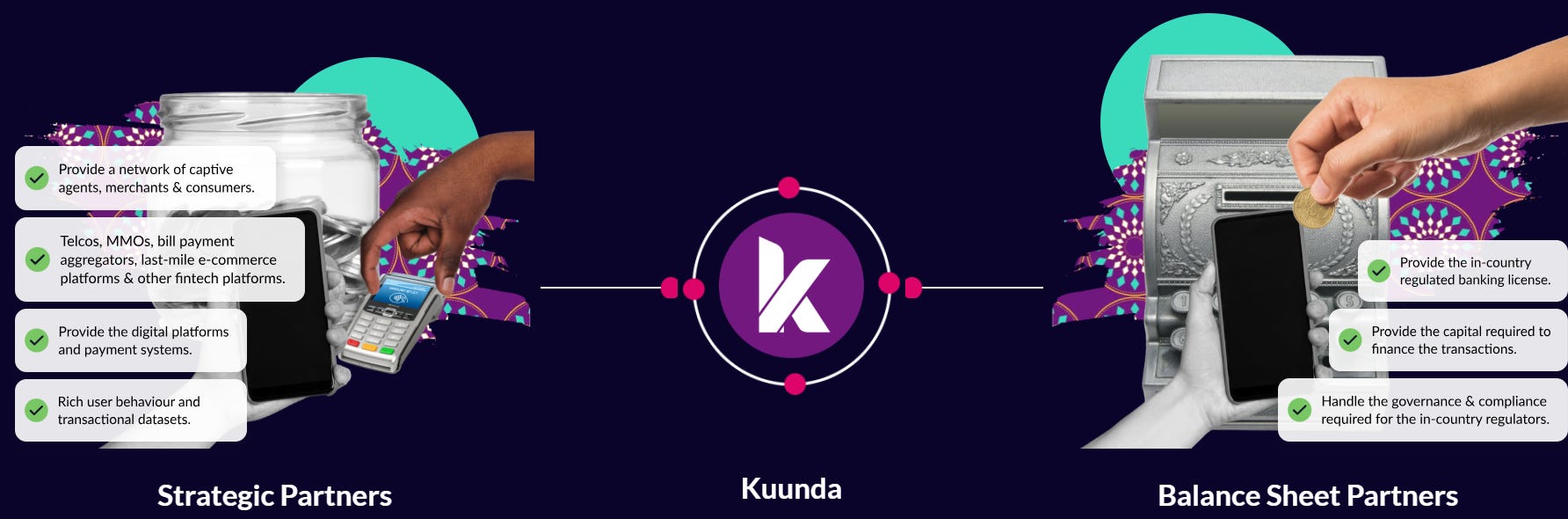
The company embeds analytics, loan pricing, disbursement mechanisms, and other solutions into partner platforms like M-Pesa Tanzania, building real-time borrower profiles and allowing agents to access financing for operational needs.
The proceeds of the funding round will be used to deepen Kuunda’s partnership network, develop new financing products, and enter Egypt, Morocco, Saudi Arabia, the UAE, and other markets in the MENA region.
Revenue model: Kuunda operates a revenue-sharing model instead of charging upfront fees. Once a financial product is deployed to end-borrowers (e.g, M-Pesa Tanzania agents), the resulting income is split between Kuunda, the strategic partner (e.g., M-Pesa Tanzania), and the balance sheet partner (e.g., Finca).
Key metrics & successes:
Since 2018, Kuunda has powered more than $3B in loans.
It currently operates in Tanzania, Uganda, Malawi, Ivory Coast, and Zambia, recently launched Kenya and Mozambique, and also operates in Pakistan.
Kuunda powers over 85% of M-Pesa Tanzania’s loan volume with a non-performing loan rate under 2%.
Key strategic partners: M-Pesa, Airtel Money, OneLoad Pakistan, Udhaar
Key balance sheet partners: Finca, Mansa, I&M, CreditBook, Mwanga Hakiki

Key personalities:
Andrew Milne, Co-founder and co-CEO
Morne van der Westhuizen, Co-founder and co-CEO
Sam Brawerman, Co-founder and CPO
Erik Van Veen, Partner at Portugal Gateway Fund
Bruce Nsereko-Lule, General Partner at Seedstars Africa Ventures
In the Founder’s words: “We are unlocking access to finance for Africa’s productive class: the agents, merchants, and small businesses that are the backbone of these economies, whilst helping consumers build up resilience by accessing credit when they need it the most.” — Andrew Milne
In the Investor’s words: “Kuunda’s data-driven, behaviorally based credit scoring gives banks and capital providers the confidence to serve the informal economy at scale. By turning billions of digital transactions into actional risk insights, Kuunda makes last-mile lending sustainable, repeatable and profitable. We’re excited to back a team helping create the inclusive credit rails for the continent.” — Erik Van Veen
“Across our markets, we repeatedly see agents, MSMEs, and consumers constrained by cashflow. Kuunda’s embedded working-capital products unlock liquidity exactly where commerce happens: at the edge.” — Bruce Nsereko-Lule.
Go deeper: The team at Kuunda have deep sector expertise, having previously worked at one of Africa’s first mobile-money platforms, Zoona, as well as Vodacom, Tigo, Airtel, MTN, and Orange.
Bottom line: Kuunda exemplifies the opportunity for agent network infrastructure providers we described in ’How offline agent networks are driving Africa’s digital development.’ Moreover, the company’s combination of product-market fit, founder-problem-fit, asset-light scalability, and ambitious expansion plans makes it a compelling startup to watch develop in the coming years.

Deal Digest
Announced this week: Over $30M in disclosed new funding to thirteen African startups. Plus one M&A deal and one upcoming Series A. Here’s the full list:
EQUITY
Chari, a Moroccan B2B marketplace & fintech platform for the FMCG sector, raised $12M from SPE Capital and Orange Ventures in a Series A round.


Investor News
Chocolate City Group, one of Africa’s leading media & entertainment companies, launched a $1M Founders Fund, which will make $20-$50K investments in creative economy startups across Africa.

Chocolate City Group Chairman Audu Maikori told me on Thursday that the objective of the Founders Fund is to help catalyze the continent’s creative sector via ‘patient capital’ to ‘sustainable creative businesses’ whom financial institutions and other investors sometimes struggle to understand.
Other investor news:
News of the Week
Google announced the 10 startups selected for the Google for Startups Accelerator program in South Africa.
The COMESA Competition Commission (CCC), the regional watchdog that oversees competition and consumer protection across Eastern and Southern Africa, opened a formal inquiry into the merger between Kenya’s Wasoko and Egypt’s MaxAB.
After completing the takeover of South Africa’s MultiChoice, France’s Canal+ plans to delist MultiChoice from the Johannesburg Stock Exchange and pursue a secondary inward listing of Canal+ on the JSE.
DHL plans to invest more than $350M in warehouses and other infrastructure in Africa to capitalize on demand from sectors such as e-commerce and renewable energy. Most of DHL’s Africa operations, which include warehousing, packaging, and supply-chain management, are in South Africa, Egypt, and Kenya.

Recommended Reads

A brief post-mortem from a co-founder & former CEO of insect protein startup Inseco (Simon Hazell - LinkedIn) | “Loadshedding … had a profoundly negative impact on our business…[but] loadshedding is not the only reason we failed. We made some bad hires. We scaled too quickly and pivoted too slowly.”
Pair with: The business of black soldier flies
Financing electricity access in Africa (International Energy Agency - PDF) | “Nearly two out of every five people in Africa – around 600 million in total – still live without access to electricity. Electrification has barely kept pace with population growth, leaving the continent far behind the targets set by African governments and the international community.”


Intelligence at a Glance
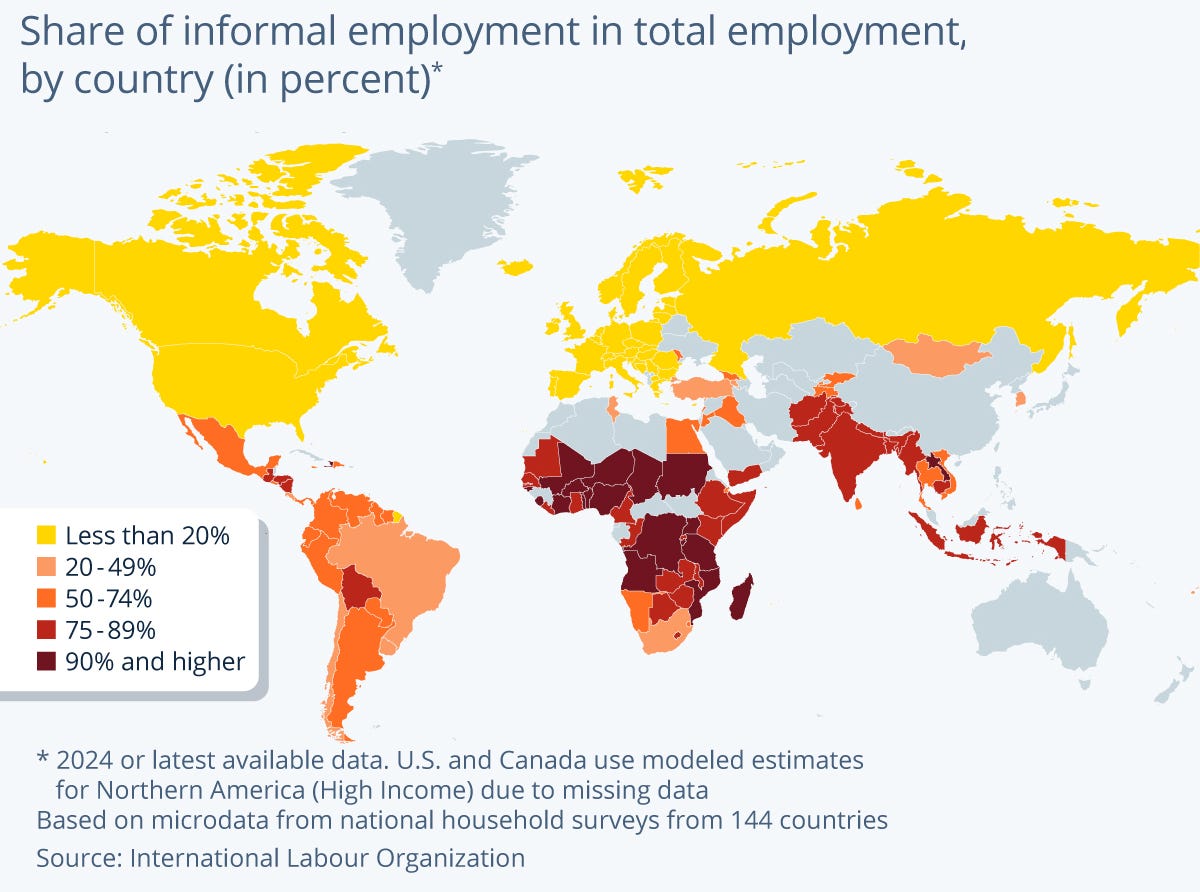
The informal economy accounts for 75-90% of employment across most African countries. Yet traditional finance has historically overlooked the segment.
Companies like Kuunda are building the plumbing to help financial institutions reach informal workers efficiently and serve them profitably.
Far from ‘disrupting’ traditional finance, they’re building parallel infrastructure for the 600M+ workers traditional finance never served.
Pair with: The hierarchy of venture opportunities in emerging markets

Last Word
Lots of great conversations happened in Lagos last week.
Many thanks to Tomiwa and the TechCabal team for a great Moonshot conference. And thanks also to Fadilah, Yemi, and the African Business Angel Network team for a great ABAN Congress.
Thanks also to Joe, Zeph, and the HoaQ and the TSNP teams for a great side event. And thanks to Chapter54, Delta40, Madica, DCG, Norrsken22, Partech, Novastar, and various hosts of other side events.

Some questions/topics I jotted down:
Climate tech in Africa: market-driven or mandate-driven? If the climate agenda in Africa’s tech sector is being pushed by LPs overseas rather than pulled by the domestic market, should we all be more wary than seems to be the case?
Should media — Afridigest included — be more critical of founders building for African markets from abroad? If a founder moves out of the continent away from the customers/clients/communities he/she serves, what impact does that have on his/her effectiveness?
Africa’s creative economy is attracting more & more attention, but do creative economy businesses face more headwinds than proponents realize? Will the most significant commercial opportunities for the foreseeable future be infrastructure plays (e.g., Filmmakers Mart)?
If Nigeria is one of Africa’s top fintech hubs, why did it take a parade of POS devices for one man (pictured in a photo above) to make a payment? Are Nigeria’s/Africa’s top fintech founders over-celebrated relative to the actual market impact of their companies?
Is VC value-add a myth in African markets? Are many/most VC investors on the continent knowledgeable/rigorous/curious enough about the markets they invest in to provide real support to founders?
If the African continent is facing a jobs crisis — and it certainly is — is focusing on tech startups the right approach? What are the limitations of a startup-centric approach and what are the best alternatives?
I’d love to hear your thoughts, dear reader 🙏🏽
Thanks for reading the Afridigest Executive Brief. If you liked this edition, click the ❤︎ to let us know, then share it with a friend or colleague:
Afridigest is a media & strategic intelligence platform focused on ideas, analysis, and insights to help Africa-focused business leaders succeed.
For consulting and advisory projects, email intelligence@afridigest.com and visit Afridigest Intelligence.
To submit an opinion essay for publication, email submissions@afridigest.com and read the Submission Guidelines.
To reach our audience or discuss potential partnerships, email partnerships@afridigest.com and visit Partner Stories.
For Q&A, email emeka@afridigest.com